


One of the most frequently asked questions is: how does a hot air balloon work?
How is it possible for a hot air balloon to lift off from the ground, travel through the sky, and then descend gently back to the earth?
The principle behind hot air balloon flight is actually very simple and is based on a fundamental law of physics: hot air is lighter than cold air and therefore rises, while cold air sinks.
It is precisely this principle that makes the hot air balloon work—a means of flight that is as fascinating as it is intuitive.
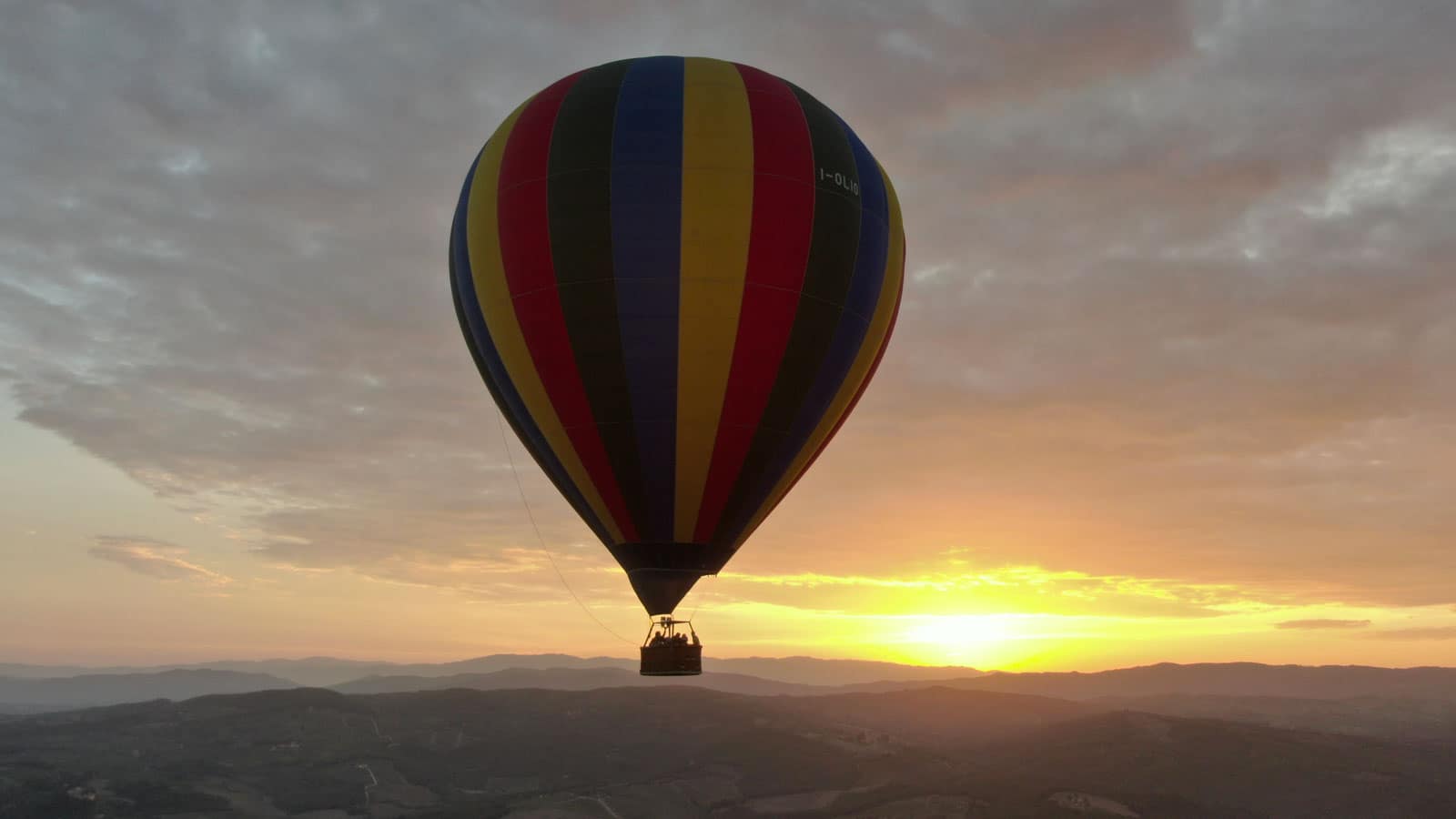
How a hot air balloon flies: the role of hot air
The mechanism that explains how a hot air balloon flies is made possible by the burner, the true engine of the balloon, positioned between the basket and the envelope.
The burner heats the air “trapped” inside the envelope. As the air warms up, it becomes less dense than the surrounding air, allowing the balloon to lift off and float in the sky, in a way very similar to a boat floating on water.
By reducing the internal temperature, the balloon slowly begins to descend, enabling the pilot to precisely manage the descent and landing phase.
This is the core principle behind how a hot air balloon works.
Now that you know how safe hot air ballooning is, you can start imagining your experience.
What can the pilot control during the flight?
In a hot air balloon flight, the only movements that can be directly controlled are the vertical ones:
- ascending
- descending
This is precisely why the flight is considered extremely natural and stable. The pilot controls altitude by adjusting the temperature of the air inside the envelope, making precise and constant use of the physical principle behind hot air balloon flight.
How is a hot air balloon steered during flight?
At this point, a natural question arises: how is a hot air balloon steered if the pilot can only control altitude?
The answer lies in air currents. At different altitudes, winds blow with varying directions and strengths, which the pilot carefully studies and understands before takeoff.
By changing altitude, it is possible to intercept the desired air current and be carried along by it. This is why hot air ballooning is described as a “passive” form of flight: even though it is guided by the pilot’s experience, it is ultimately the wind that determines the route, gently carrying the balloon across the sky.
This is what makes every flight unique and unrepeatable.
Would you like to know how a hot air balloon flight works?
Why is the hot air balloon envelope so large?
Another very common curiosity concerns the size of the balloon.
Many people wonder why the hot air balloon envelope is so large compared to the basket.
The answer lies in the need to contain a large volume of hot air, enough to lift:
- the weight of the basket
- the passengers
- the equipment
- the pilot
The greater the volume of the envelope, the greater the upward lift it can generate, allowing the balloon to fly in a stable, smooth, and safe way. This is a fundamental element in ensuring a comfortable and reliable hot air balloon flight.

How a hot air balloon works: simple, natural, and fascinating
In summary, the way a hot air balloon flight works is based on simple, natural, and unchanging principles. It is precisely this simplicity that makes the hot air balloon one of the most fascinating and intuitive aircraft ever created.
Understanding how a hot air balloon works also means appreciating the beauty of a silent, slow flight, in complete harmony with the air and the wind.